Most retailers can tell you last month's sales down to the dollar. Ask them how many people walked in to produce those sales, and the room goes quiet. That gap is the whole problem: 91% of clothing retailers don't know their store's conversion rate, because they're only counting the shoppers who bought, not the ones who left empty-handed.
A people counter for your retail store closes that gap. It tells you how many visitors you get, when they show up, and what share of them actually buy. The hard part isn't deciding whether you need one. It's choosing the right kind, because the options range from a $40 beam at the door to camera systems that need IT support and raise real privacy questions.
This guide breaks down the main types of people counters, what they actually cost once you add everything up, and how to match the right one to your store.
What a People Counter Actually Does for a Retail Store
At its simplest, a people counter tracks how many people enter your store. On its own, that number is interesting. Paired with your sales data, it becomes the most useful metric you have.
Once you know your traffic, you can calculate conversion rate (the percentage of visitors who buy). You can see your true peak hours instead of guessing. You can tell whether last weekend's promotion brought people through the door or just discounted the customers you already had. And if you run more than one location, you can finally compare stores on the same footing.
The payoff is concrete. Stores are mis-staffed roughly 86% of the time, scheduling for the hours that feel busy rather than the hours that are. And a 10% drop in conversion can quietly cost a single location $5,000 to $7,000 a month, the kind of leak you only catch when you're measuring traffic against sales. For the full picture on that, see our guide to why conversion rate matters more than foot traffic.
The Main Types of People Counters
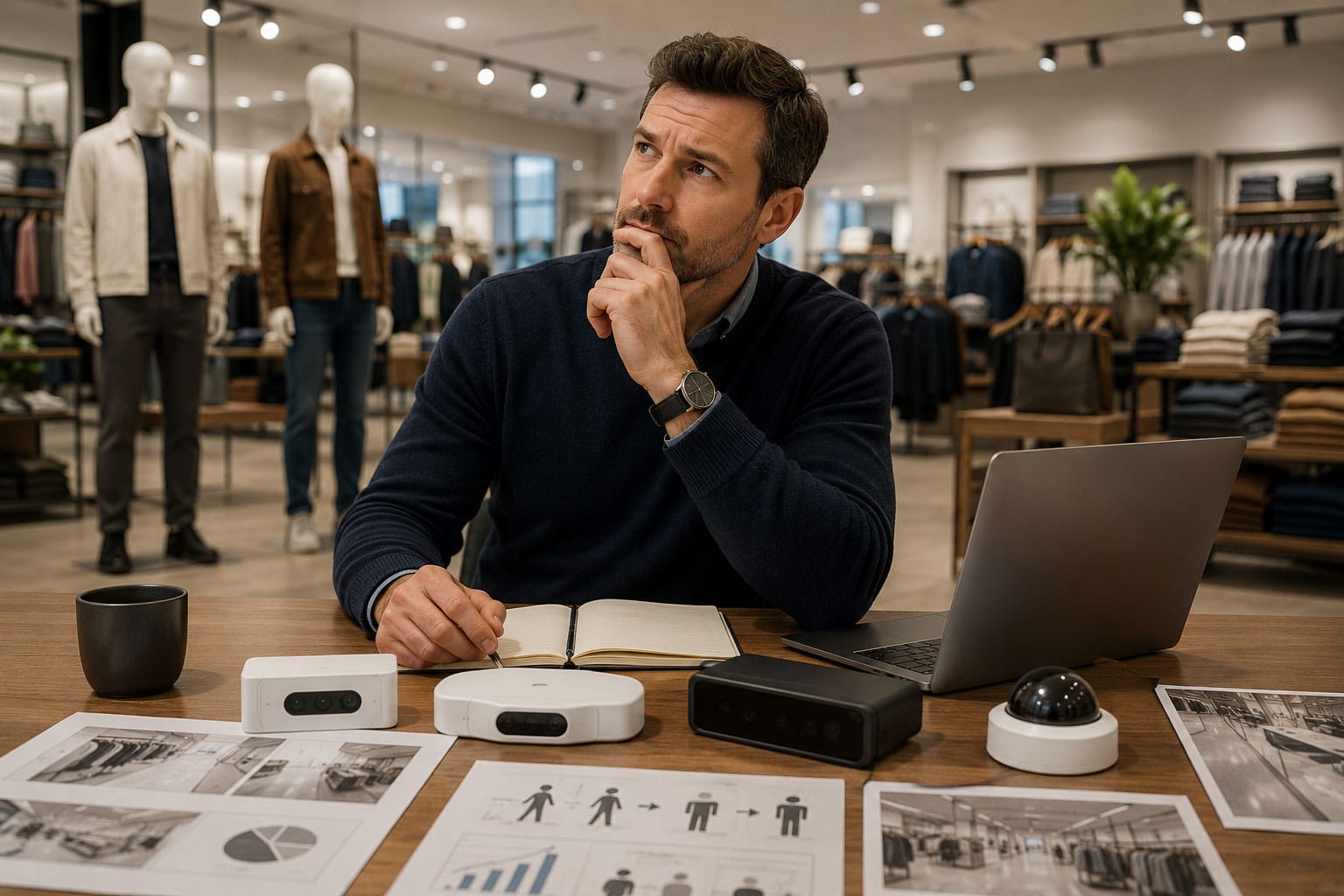
Not all traffic counters work the same way, and the technology you choose affects accuracy, privacy, installation, and price. Here are the four you'll run into when shopping for a people counter for your retail store.
Break-Beam (Infrared) Counters
These are the entry-level option: an infrared beam across the doorway that registers a count each time someone breaks it. They're cheap and simple, which is the appeal.
The trade-off is accuracy. A single beam can't tell direction, can't separate two people walking in side by side, and counts a shopping cart or a swinging door the same as a customer. For a narrow single-door boutique with light traffic, they can be good enough. For anything busier, the error adds up fast.
Camera and Video Counters
Camera-based counters use overhead video and computer vision to count and often to track movement through the store. They're accurate and feature-rich, and many retailers already have cameras installed.
The catch is everything around them. Cameras capture personally identifiable images, which puts you squarely inside GDPR and other privacy regulations and makes some customers uneasy. They typically need wiring, network bandwidth, and IT involvement to install and maintain. If you want a deeper look at this trade-off, we compared the two approaches directly in thermal vs. camera people counters.
Wi-Fi and Bluetooth Counters
These estimate traffic by detecting signals from shoppers' phones. They can offer extras like dwell time and repeat-visit estimates.
But they only count people who have Wi-Fi or Bluetooth switched on, so they miss a meaningful share of visitors and lean on assumptions to fill the gap. Phone privacy changes that randomize device identifiers have made this approach less reliable over time. Treat the numbers as estimates, not hard counts.
Thermal Sensors
Thermal counters detect body heat rather than images, using machine learning to count people as they pass underneath. They hit the accuracy of camera systems without capturing anything that identifies a person, so counts stay 100% anonymous and GDPR-compliant.
Because there's no image to process, the hardware can be small, battery-powered, and cellular-connected. That removes the wiring, the Wi-Fi dependency, and the IT project that the other accurate option requires. Dor pioneered this category as the world's first thermal-sensing, battery-operated people counter, and the sensor installs in minutes with no calibration.
What a People Counter Really Costs
Sticker price is only part of the story. To compare options honestly, add up four things.
Hardware. A break-beam counter can be $40 to a few hundred dollars. Camera systems and thermal sensors generally run a few hundred dollars per unit. Dor hardware, for example, is a $300 one-time cost per sensor.
Software and reporting. A counter that only shows a running tally isn't worth much. The value is in the dashboard that turns counts into conversion rates, peak-hour views, and multi-store comparisons. Expect a monthly subscription here. Dor's software is $150 per month per sensor, or $135 per month billed annually, with every feature included.
Installation and IT. This is the cost people forget. Wired and camera-based systems often need a professional install, network configuration, and ongoing IT support. A peel-and-stick thermal sensor has none of that, which can save more than the hardware itself.
Maintenance. Factor in battery or power, firmware updates, and replacements. A sensor with a battery that lasts two years and updates over the air costs far less to keep running than a wired system someone has to service on site.
When you total all four, the cheapest sticker price is rarely the cheapest counter. A $40 beam that miscounts your traffic and needs an electrician costs more in bad decisions than an accurate sensor that installs itself.
How to Choose the Right People Counter
Run any option you're considering through these seven questions.
- Accuracy: Does it count reliably in both directions, and can it handle two people entering at once? Ask for a verified accuracy figure, not a vague claim.
- Privacy: Does it capture images or personal data? Anonymous counting keeps you clear of GDPR headaches and customer concerns.
- Installation: Does it need wiring, a professional installer, or IT setup, or can your team put it up the same day?
- Connectivity: Does it depend on your store Wi-Fi, or does it connect on its own? Cellular sensors keep working when the network doesn't.
- POS integration: Can it connect to your point-of-sale so you get conversion rate automatically, not just raw traffic?
- Multi-location: If you run several stores, does the dashboard let you compare them in one place?
- Total cost of ownership: Add hardware, software, installation, and maintenance over two to three years, then compare.
Matching the Counter to Your Store
A single low-traffic doorway on a tight budget can get by with a break-beam counter, as long as you accept the accuracy limits. A retailer who already runs a managed camera network and has IT support may extend it to counting. But most independent and multi-location retailers want accurate, private counts without an IT project, and that's where a thermal sensor fits best.
Whatever you choose, the counter is only the start. The real return comes from acting on the data: staffing to your actual peaks, measuring whether marketing brings people in, and watching conversion rate the way you watch sales. Our complete guide to foot traffic analytics walks through how to put those numbers to work.
The Bottom Line
The best people counter for your retail store is the one that gives you accurate, private counts you can trust, without a wiring project or a privacy liability hanging over it. Compare on total cost, not sticker price, and weigh accuracy and privacy as heavily as the number on the invoice.
If you want to see what accurate, anonymous counting looks like in your store, Dor's people counting installs in minutes and starts tracking conversion from day one.