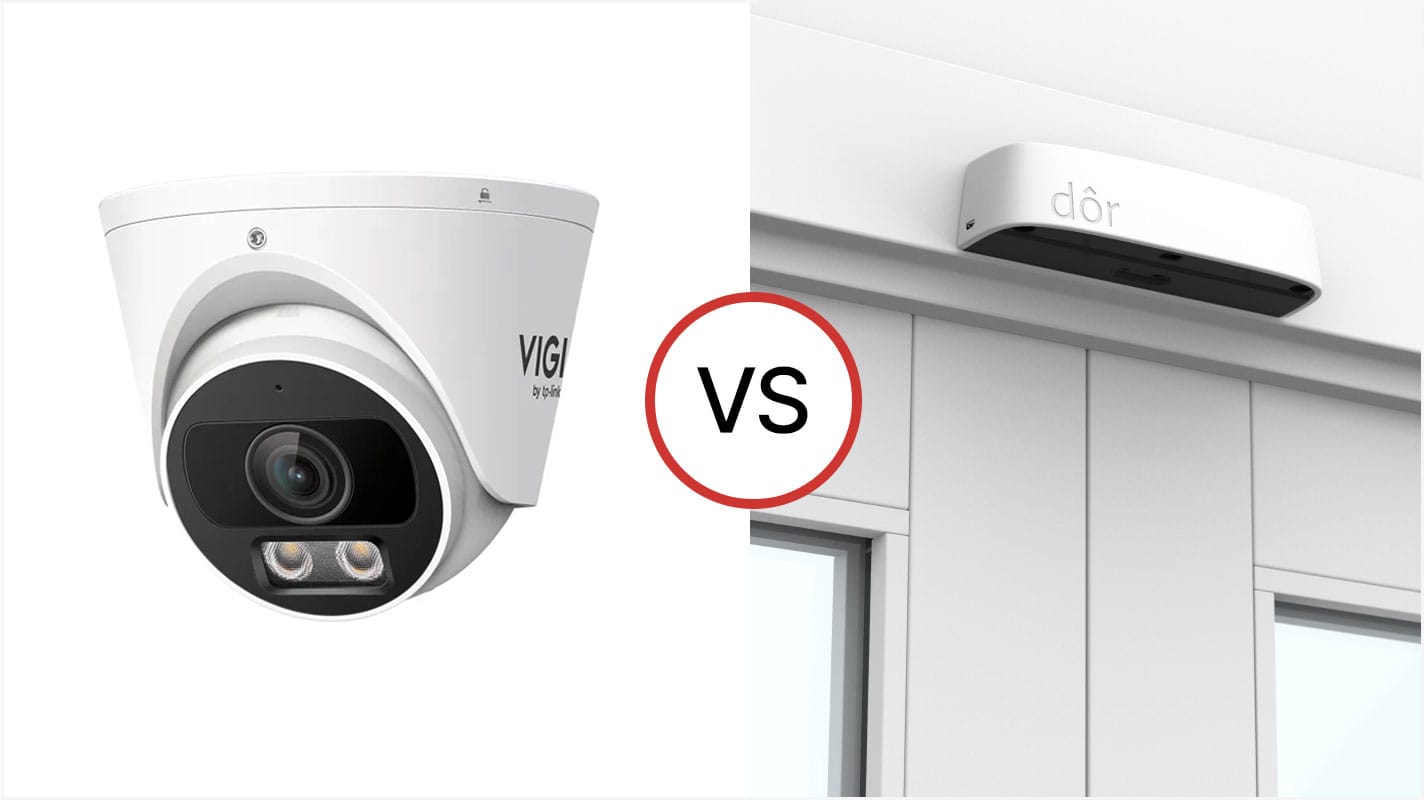
If you're shopping for a people counter, you've probably landed on two main options: camera-based systems and thermal sensors. Both promise accurate foot traffic data. Both claim to help you make smarter store decisions. But they work in fundamentally different ways, and those differences matter more than most comparison guides let on.
Here's an honest look at how these two technologies stack up on the things retail operators actually care about: accuracy, privacy, cost, and how fast you can get them running.
How Each Technology Works
Camera-based people counters use overhead video to identify and count individuals walking through a space. The camera captures visual footage, and software processes it to distinguish one person from another, even in groups. Some advanced systems add heatmaps, dwell time, and demographic analysis on top of the count.
Thermal sensors take a different approach entirely. Instead of capturing video, they detect the heat signatures radiating from people's bodies. When someone walks beneath the sensor, the thermal array registers the change and logs a count. No images. No video. No personally identifiable information at any point in the process.
Both approaches get you to the same core metric: how many people walked into your store. The question is what else comes with it.
Accuracy: Closer Than You Might Think
Camera systems have long been considered the gold standard for counting accuracy. And for good reason: video-based counting with modern computer vision is precise.
But thermal sensing has closed that gap significantly. Dor's thermal sensors use machine learning algorithms that continuously improve counting accuracy over time, delivering results that match camera-level precision. Across 2,000+ retail locations, the data backs this up.
The practical difference in accuracy between a well-calibrated camera system and a modern thermal sensor is minimal for most retail use cases. If your goal is tracking conversion rates, identifying peak hours, and optimizing staffing, both technologies deliver the data you need.
Where cameras pull ahead is in the extras: demographic breakdowns, shopper path analysis, and dwell-time mapping. If those capabilities are critical to your operation, cameras offer more. But for the vast majority of independent and multi-location retailers, traffic counts and conversion data are the metrics that actually drive decisions.
Privacy: The Gap That Keeps Widening
This is where the two technologies diverge sharply.
Camera-based systems capture visual images of every person who enters your store. Even with face-blurring software, the underlying footage still contains personally identifiable information. That creates real exposure under privacy regulations like GDPR, and it raises questions about customer trust that retailers increasingly have to answer.
Some camera vendors offer edge processing that blurs faces before data leaves the device. That helps, but it doesn't eliminate the core issue: a camera still captures the image before it blurs it. If that device is compromised, or if regulations tighten (as they have been trending globally), you're carrying compliance risk that doesn't go away with a software update.
Thermal sensors sidestep this entirely. A thermal array detects heat, not faces. There is no image to blur because no image is captured. Dor's sensors are 100% anonymous and GDPR-compliant by design, not by configuration. For retailers operating in privacy-conscious markets, or those who simply don't want to explain to customers why there's a camera pointed at the door, that distinction matters.
Installation and Deployment: Minutes vs. Weeks
If you've ever tried to roll out camera-based counters across multiple locations, you know the drill: IT involvement, power and wiring requirements, mounting hardware, network configuration, and often a professional installer at each site. For a 50-store chain, that's a project measured in weeks or months.
Dor's thermal sensors are battery-powered and cellular-connected. You peel the adhesive backing, stick it above your entrance, and it starts counting. No wires, no Wi-Fi dependency, no IT tickets. The battery lasts over two years. A single store can be up and running in under five minutes, and a multi-location rollout happens in days, not quarters.
This isn't just a convenience difference. It's a cost and speed-to-value difference. Every week you spend deploying cameras is a week without the data you need to optimize staffing and track performance. For operators managing multiple stores, deployment friction is often the real bottleneck, not the sensor itself.
Cost: Total Ownership, Not Just Sticker Price
Camera systems typically carry higher upfront hardware costs, professional installation fees, and ongoing maintenance. Enterprise-grade platforms like RetailNext and ShopperTrak serve large retail chains well, but their pricing and deployment models aren't built for independent operators or growing multi-location brands.
Dor's hardware costs $300 per sensor as a one-time purchase, with software at $150 per month per sensor ($135 on an annual plan). Every feature is included in every plan. No tiers, no add-on modules, no surprise fees. Combined with self-installation and a 30-day money-back guarantee, the total cost of ownership is transparent from day one.
For retailers evaluating people counting options, the math often comes down to this: camera systems offer more data types at a higher total cost and longer deployment timeline. Thermal sensors deliver the core metrics that drive store decisions at a fraction of the cost with near-zero deployment friction.
Which One Is Right for Your Store?
There's no universal answer. Camera-based systems make sense for large enterprise retailers who need advanced analytics like heatmaps and demographic profiling, and who have the IT infrastructure and budget to support them.
For everyone else, the question worth asking is: what data do I actually need to make better store decisions? If the answer is foot traffic, conversion rates, peak hours, and staffing insights, a thermal sensor gets you there faster, at lower cost, with zero privacy risk.
Dor was built by former Apple engineers (from the iPod and iPhone teams) specifically to solve this problem: give physical retailers the kind of data that e-commerce takes for granted, without the complexity and cost that kept most stores locked out. Over 2,000 retail locations have made that choice.
If you're curious what your store's real numbers look like, see how Dor works.